

Rexxam FIELDNavigator
Abstract
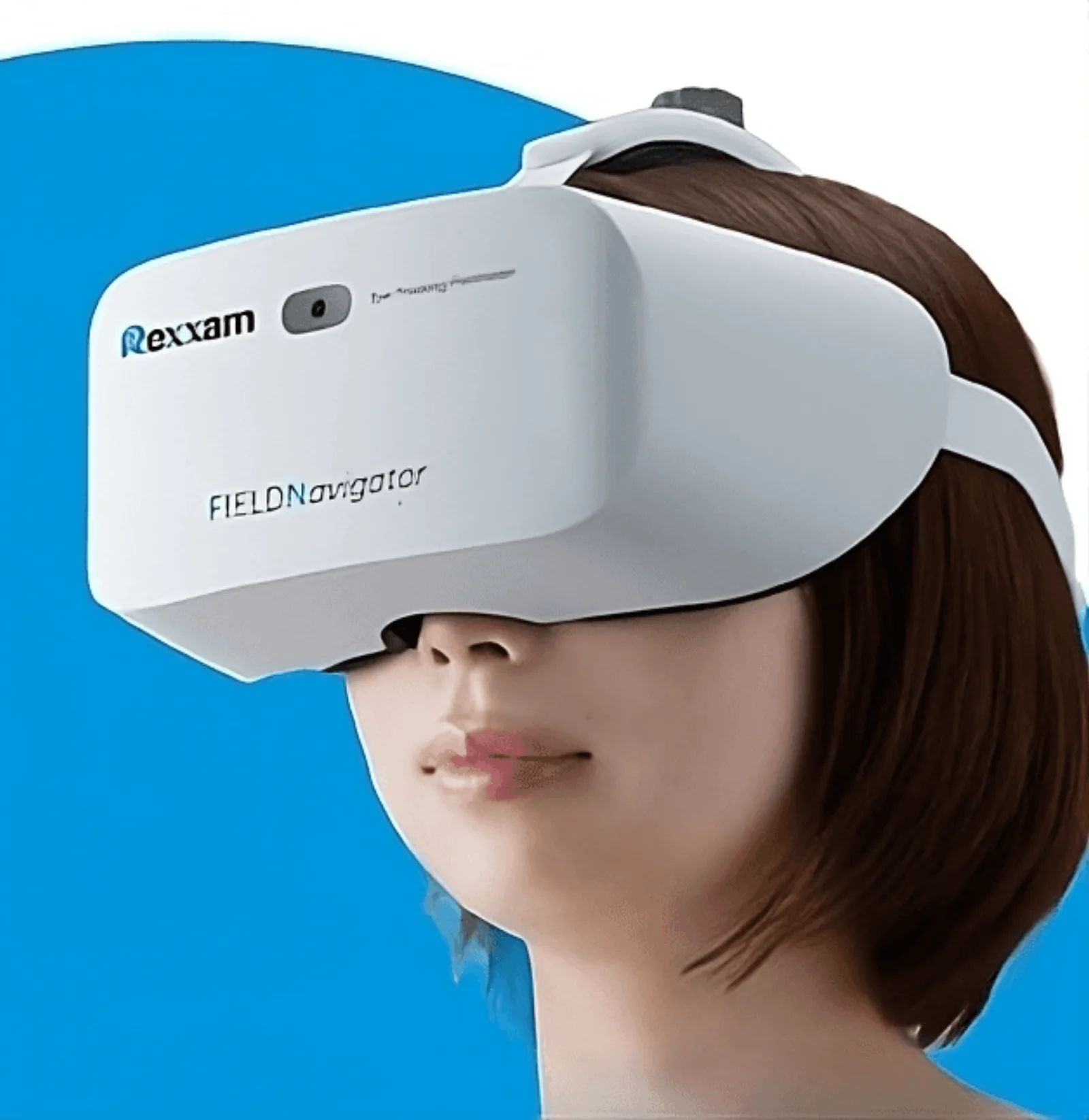
The Rexxam FIELDNavigator represents a revolutionary breakthrough in visual field testing, utilizing innovative eye-tracking technology to eliminate the traditional button-pressing requirement, thereby reducing false positives and negatives while providing more objective and reliable assessments.
Core Technology
Gaze-Tracking System
The FIELDNavigator employs sophisticated oculomotor tracking sensors integrated into a lightweight, head-mounted unit. The system continuously monitors:
- Pupil Position: High-resolution tracking of pupil location and movement
- Saccadic Movements: Detection of rapid eye movements between fixation points
- Fixation Patterns: Analysis of gaze stability and micro-movements
- Blink Response: Monitoring of eyelid movements and blink patterns
Stimulus Detection Algorithm
The device uses proprietary algorithms to interpret eye movement patterns as responses to visual stimuli:
- Baseline Calibration: Establishes individual patient's normal eye movement patterns during pre-test calibration
- Stimulus Presentation: Projects light stimuli at predetermined visual field locations
- Response Detection: Analyzes eye movement changes following stimulus presentation
- Pattern Recognition: Differentiates between genuine stimulus responses and random eye movements
- Real-time Processing: Provides immediate feedback and test progression
Hardware Design
Head-Mounted Configuration
- Ergonomic Design: Lightweight headset that maintains consistent positioning without chin rest dependency
- Integrated Optics: Built-in stimulus projection system with precise spatial control
- Eye-Tracking Sensors: Multiple high-speed cameras and infrared sensors for binocular monitoring
- Adjustable Optics: Accommodates various interpupillary distances and refractive errors
Stimulus Presentation System
- LED Array: High-intensity, calibrated light sources positioned throughout the visual field
- Dynamic Range: Variable stimulus intensities from threshold to suprathreshold levels
- Spatial Resolution: Precise stimulus positioning with sub-degree accuracy
- Temporal Control: Millisecond-precise stimulus timing and duration control
Working Mechanism
Test Protocol
- Patient Positioning: Head-mounted unit is fitted and adjusted for optimal eye tracking
- Calibration Phase: System learns patient's baseline eye movement patterns
- Fixation Monitoring: Continuous verification of central fixation throughout testing
- Stimulus Sequence: Automated presentation of stimuli following standard perimetric patterns
- Response Analysis: Real-time interpretation of eye movement responses
- Data Integration: Compilation of results into standard visual field maps
Response Detection Process
The system identifies stimulus perception through characteristic oculomotor responses:
- Microsaccades: Small, involuntary eye movements that increase in frequency upon stimulus detection
- Pupillary Response: Subtle changes in pupil size following visual stimulation
- Attention-Related Movements: Eye movement patterns indicating covert attention shifts
- Fixation Behavior: Changes in fixation stability when peripheral stimuli are detected
Technical Specifications
Performance Parameters
- Spatial Resolution: Sub-degree stimulus positioning accuracy
- Temporal Resolution: Millisecond-level response detection
- Dynamic Range: 40+ dB stimulus intensity range
- Test Duration: Typically 20-30% faster than conventional perimetry
- Repeatability: Enhanced test-retest reliability due to elimination of response variability
System Requirements
- Power Supply: Standard AC power with battery backup capability
- Data Storage: Digital storage of test results and eye movement recordings
- Connectivity: Network integration for electronic health records
- Calibration: Automated daily calibration with periodic professional maintenance
Clinical Implementation
Operational Advantages
Elimination of Response Errors:
- No false positives from premature button pressing
- No false negatives from delayed or missed responses
- Reduced impact of patient fatigue on test accuracy
Enhanced Patient Experience:
- Passive testing reduces cognitive load
- Improved accessibility for patients with motor impairments
- Reduced test anxiety through elimination of performance pressure
Operator Benefits:
- Reduced need for patient coaching and re-testing
- More consistent results across different operators
- Automated quality control and reliability indices
Compatibility Features
Hybrid Response Options: The system maintains compatibility with conventional response switches for patients with:
- Central vision loss affecting gaze tracking accuracy
- Neurological conditions that might interfere with normal eye movements
- Patient preference for traditional testing methods
Standard Integration: Results are presented in formats compatible with existing perimetric databases and progression analysis software.
Quality Assurance
Validation Systems
- Real-time Quality Control: Continuous monitoring of fixation stability and response consistency
- Automated Reliability Indices: Generation of standard perimetric reliability parameters
- Calibration Verification: Regular system calibration checks and performance validation
- Data Integrity: Secure storage and transmission of test results and eye movement data
Clinical Validation
The system has undergone extensive testing to ensure correlation with established perimetric methods while providing enhanced reliability and reduced measurement variability.
Technical Innovation
The FIELDNavigator represents a convergence of multiple advanced technologies:
- Computer Vision: Advanced image processing for real-time eye tracking
- Machine Learning: Adaptive algorithms that learn individual patient response patterns
- Optical Engineering: Precise stimulus delivery and eye monitoring systems
- Signal Processing: Real-time analysis of complex oculomotor signals
- Ergonomic Design: Patient-centered hardware design for comfort and accessibility
This integration of technologies creates a perimetric system that maintains the diagnostic accuracy of traditional methods while addressing their fundamental limitations through objective, response-independent measurement techniques.
Visreed