

OCTOPUS 600 PERIMETER
Abstract
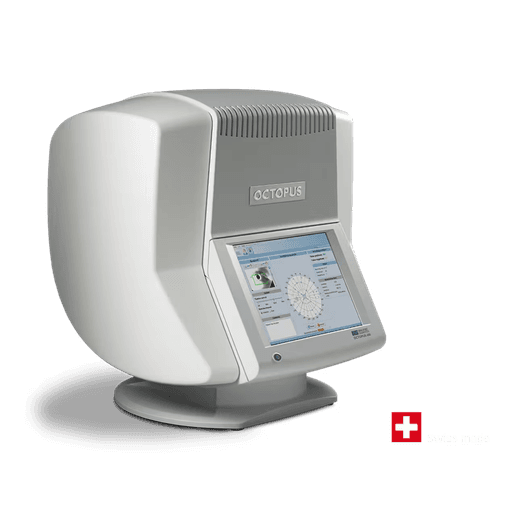
The Octopus 600 is an automated static perimeter manufactured by Haag-Streit Diagnostics, designed for visual field testing
Primarily for the detection and monitoring of glaucoma. It combines two testing modalities in one compact, standalone device: standard white-on-white perimetry and the proprietary Pulsar early detection method.
It is notably darkroom-independent, meaning it can be operated in normal clinical lighting conditions.
Key Technical Specifications
Display & Stimulus Generation
- Uses a TFT-based monitor to generate both stimuli and background illumination — the first visual field analyzer to perform standard white-on-white perimetry on an integrated flicker-free screen using TFT and LED technology.
- Background illumination is maintenance-free LED-based.
Optical / Patient Interface
- The binocular system accommodates a set of corrective lenses ranging from -8 to +4 D.
- Built-in video camera for continuous fixation monitoring.
Pulsar Technique Parameters
- Background luminance: 32 cd/m²; stimulus range: ~35 src; stimulus size: 5; stimulus duration: 500 ms at a frequency of 10 Hz. Compatible with Gp and 32p programs.
- The Pulsar test presents a contrast-modulated ring target that flickers at 10 Hz, combining both contrast sensitivity and flicker sensitivity in a single measurement.
Test Patterns & Strategies
The Octopus 600 includes a comprehensive library of central visual field test patterns: G, M, 24-2, 24-2C, 30-2, 32, and 10-2.
Two unique physiology-based patterns are particularly notable:
- The G-Program covers a 30-degree field optimized for glaucoma assessment, and the M-Program covers a 10-degree field for macular analysis. Both are correlated with a nerve fibre bundle map to test the most diagnostically relevant points, with higher stimulus density in the center to help discover paracentral scotomas often missed by the standard 32 pattern.
Examination Speed
- With the TOP (Tendency Oriented Perimetry) strategy, full threshold testing is reduced by nearly 80%, completing in just 2–4 minutes, compared to 6–8 minutes with the Dynamic strategy or 10–12 minutes with the Normal strategy.
- The Glaucoma Screening Test (GST) can distinguish between normal and abnormal visual fields in under one minute.
Software & Analysis (EyeSuite)
Cluster Analysis groups visual field defects along nerve fibre bundles, combining high sensitivity with good specificity for early glaucomatous changes. It is available in both single-field and trend view.
Polar Analysis projects local visual field defects along nerve fibers to the optic disk, displayed in a structural orientation — making structure-function correlation highly intuitive.
The EyeSuite software also supports HFA data import, allowing historic Humphrey Field Analyzer data to be displayed in either Octopus or HFA-style printout formats — useful for practices transitioning between systems.
Connectivity: Can operate standalone or be networked for integration with EMR systems and other Haag-Streit devices without third-party software.
Clinical Use Case
The Octopus 600 is principally used for:
- Early glaucoma detection (Pulsar method)
- Long-term glaucoma follow-up (white-on-white perimetry)
- Routine screening in high-throughput clinical environments
- Macular assessment (M-program)
It is available in a Basic and a Pro version, the Pro adding the Cluster Analysis advanced software and the TOP Optimized Faster Threshold strategy.
Visreed