

Lenstar Myopia - Haag-Streit
Abstract
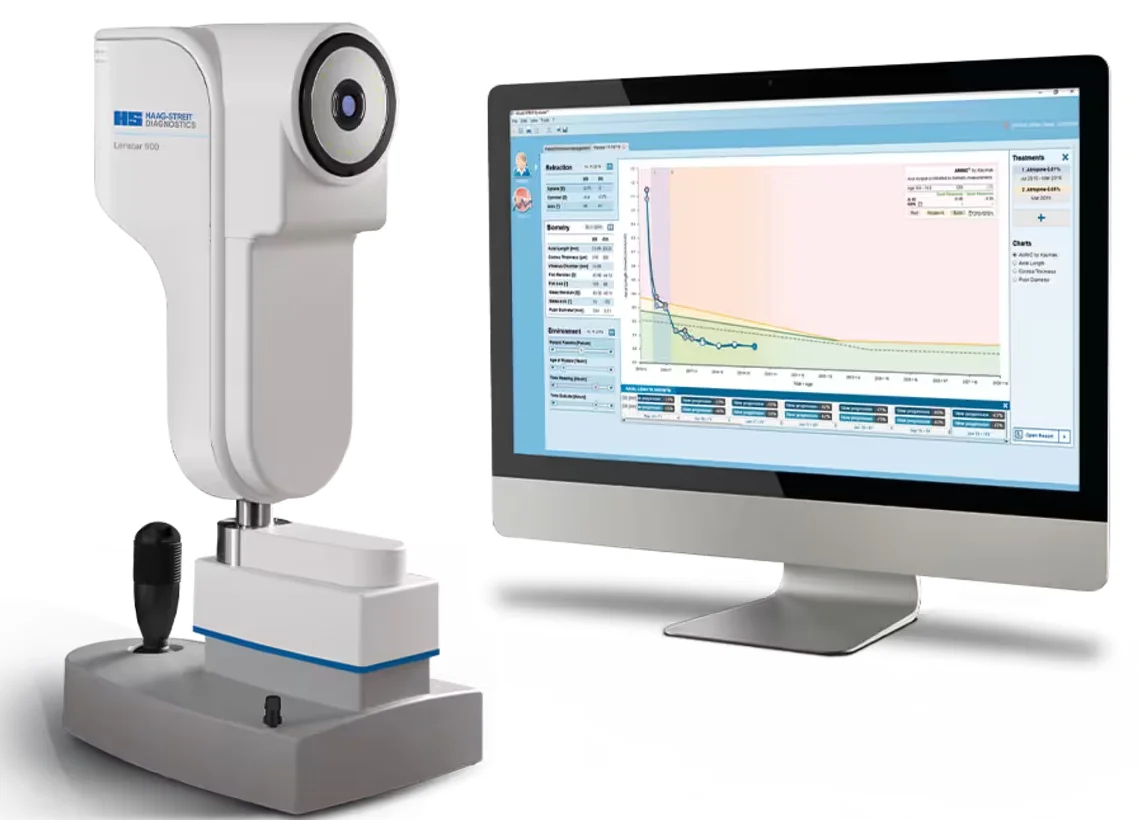
Lenstar Myopia is Haag-Streit's solution for myopia management in children. It pairs the Lenstar 900 optical biometer, with its Automated Positioning System (APS), with the EyeSuite Myopia software. The software plots a child's axial length against age- and gender-matched growth curves from Erasmus University Medical Center and uses the Age-Matched Myopia Control (AMMC) framework to judge how well a treatment is working. Results appear as color-coded zones and parent-friendly reports. It was launched in January 2021.
Core Technology Specifications
System Type: Optical biometer plus myopia management software
Hardware: Lenstar 900 with the Automated Positioning System (APS)
Software: EyeSuite Myopia module (sold as software only, for compatible Lenstar and EyeSuite installations)
Measurement Principle: Optical low-coherence reflectometry (OLCR) for axial length, with keratometry and refraction data
Reference Data: Axial length growth curves from Erasmus University Medical Center, Rotterdam, with adjustable regional trends
Analysis Framework: Age-Matched Myopia Control (AMMC), developed with Prof. Hakan Kaymak
Development: Created with myopia specialists Dr. Thomas Aller and Pascal Blaser (myopia.care)
Launch: January 2021
Target Patients: Myopic children, including pre-myopic children for early intervention
Anatomical Context: Axial Length and Myopia
Myopia in children is mainly an axial problem. The eye grows too long for its optical power, so light focuses in front of the retina. Axial length is therefore the most direct way to follow progression, because it is not affected by accommodation and shows eye growth even when the refraction changes little. Refraction remains important for the visual result, but it is a less direct measure of the growth process.
Normal eyes also lengthen during childhood. The aim of treatment is therefore not to stop growth, which would be unphysiological, but to bring growth close to the rate expected in a non-myopic eye of the same age and gender.
How the System Works
- Measurement: The Lenstar 900 measures axial length and keratometry. The APS version positions the instrument on the eye semi-automatically with eye tracking, for quicker acquisition in children
- Normative comparison: Each measurement is plotted against growth curves of the expected axial length for the child's age and gender. The curves come from myopia experts at Erasmus University Medical Center
- AMMC: The AMMC framework assesses progression by axial length, compares the child's growth rate with age-matched non-myopic norms, and treats the reduction of excess eye growth as the measure of treatment effect. If treatment brings growth down to the emmetropic rate, it achieves 100% of the possible effect
- Color-coded zones: The chart is divided into green, yellow and red zones. Green means low growth and a highly effective treatment, yellow means moderate growth and treatment recommended, and red means high growth and treatment strongly recommended
- Treatment overlay: Treatments can be added to the timeline and overlaid on the measurements. The clinician can see how the growth changed after each treatment and adjust the protocol
What the Screen Shows
In the software screen of your image, the left panel groups refraction, biometry and environment inputs. The biometry panel lists axial length, corneal thickness, vitreous chamber depth, keratometry and pupil diameter. The environment panel has sliders for factors such as parental myopia, age of onset, and time spent reading and outdoors. The central chart plots axial length over time. The right panel lists treatments, shown here with atropine entries, and offers chart options for axial length, corneal thickness and pupil diameter. An Open Report button produces the report.
These inputs and chart options come from the screen in the image. Haag-Streit's text sources describe the growth curves, AMMC and the treatment overlay, but they do not detail the environment inputs, so treat that part as a description of this screen.
Reports and Communication
- Parent reports: Graphical reports use traffic-light colors so that parents can follow the child's progress
- Counseling: The visual display supports the consultation, helping explain why a treatment is continued, changed or intensified
- Early detection: The software supports early detection, since axial measurements taken two years before onset have been reported to separate future myopes from non-myopes (Mutti et al., 2007, cited by the manufacturer's communication)
Clinical Applications
- Baseline axial length measurement in children at risk of myopia
- Follow-up of axial elongation at regular intervals
- Evaluating the effect of myopia control treatments such as low-dose atropine, myopia control lenses or orthokeratology
- Deciding when to escalate or combine treatments
- Explaining progression and treatment goals to parents
Who Can Use It
Optometrists and ophthalmologists running myopia management clinics, orthoptists and technicians who take the measurements, and practices that want to add myopia management to their services.
Comparison with Refraction-Only Follow-up
| Feature | Refraction only | Lenstar Myopia |
|---|---|---|
| Main measure | Refractive error | Axial length |
| Reference | Clinical judgement | Age- and gender-matched curves |
| Treatment effect | Estimated | Compared with emmetropic growth |
| Parent communication | Verbal | Color-coded graphic report |
| Early detection | Limited | Axial length trend from baseline |
Strengths and Limits
Strengths: Objective axial length tracking against normative curves, a clear treatment effect framework, simple color-coded communication, and a fast APS acquisition for children.
Limits: Normative curves are population averages, so they should be adapted to the child's ethnicity and region, as the software allows. It needs a Lenstar biometer, and a child must cooperate for a valid measurement. The software helps to judge a treatment, but it does not choose a treatment, which remains the clinician's decision.
About Haag-Streit
Haag-Streit is a Swiss manufacturer of ophthalmic instruments. Its diagnostics division makes the Lenstar biometers and the EyeSuite software platform.
Limitations of Available Specifications
Note: The sources reviewed are manufacturer and trade-press descriptions, so no independent validation of the AMMC zones was reviewed. The exact list of compatible Lenstar models and EyeSuite versions, the age range covered by the curves, the full list of environment inputs, the regulatory status by country and pricing were not available. Contact Haag-Streit or an authorized distributor for current requirements. This content supports clinical judgement and does not replace it.
Visreed