

Lenstar 900 - Haag-Streit
Abstract
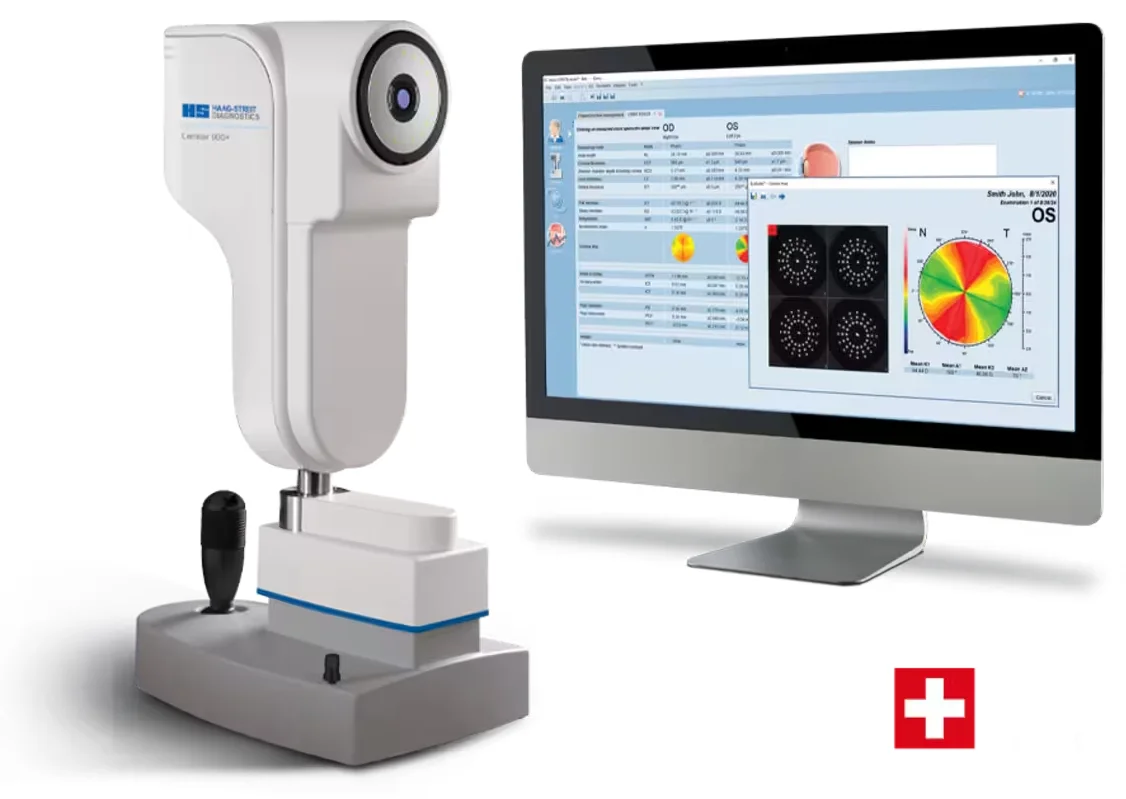
The Lenstar 900 is an optical biometer from Haag-Streit. It uses optical low-coherence reflectometry (OLCR) to measure the axial dimensions of the eye along the visual axis in a single acquisition, together with keratometry, pupillometry and white-to-white. It supports IOL power calculation, toric IOL planning, post-refractive cases and myopia management through the EyeSuite software, and it has a Dense Cataract Mode and an optional automated positioning system.
Core Technology Specifications
Imaging Platform: Optical low-coherence reflectometry (OLCR), an interferometric method, combined with digital photography
System Type: Tabletop optical biometer; Pro (manual positioning) and Pro APS (semi-automatic positioning with eye tracking) versions
A-Scan Light Source: Superluminescent diode, 820 nm
Keratometry Light Source: LED, 950 nm
Measured Parameters: Axial length, central corneal thickness, anterior chamber depth, aqueous depth, lens thickness, corneal curvature (flat and steep radii and axis), white-to-white and pupil diameter
Safety Class: Laser Class I (EN 60825-1), risk group 1 (EN 62471), device class IIa (EU 2017/745)
Dimensions and Weight: 310 x 260 x 420 mm; 6.2 kg (6.6 kg with APS)
Power: 100 to 240 V, 50 to 60 Hz mains input
Measurement Ranges and Repeatability
| Parameter | Range | Repeatability (1 SD) |
|---|---|---|
| Axial length | 14 to 32 mm | ±0.035 mm |
| Central corneal thickness | 300 to 800 µm | ±2.3 µm |
| Anterior chamber depth | 1.5 to 6.5 mm | ±0.04 mm |
| Lens thickness | 0.5 to 6.5 mm | ±0.08 mm |
| Keratometry radius | 5 to 10.5 mm | ±0.03 mm |
| White-to-white | 7 to 16 mm | ±0.04 mm |
| Pupil diameter | 2 to 13 mm | Not stated |
Resolution is 0.01 mm for the length and radius parameters and 1 µm for corneal thickness. Values come from the instructions for use of the Lenstar LS 900.
Anatomical Context: the Visual Axis
Cataract surgery and refractive planning depend on a few distances along the visual axis. The axial length runs from the corneal vertex to the retina, and the anterior chamber depth runs from the corneal endothelium to the front of the lens. The lens thickness and the corneal curvature complete the picture. Together they determine the optical power of the eye and where an intraocular lens (IOL) will sit.
In myopia, the axial length is the key biomarker, because the eye grows longer as myopia progresses. Accurate and repeatable axial length measurement is therefore used both for IOL calculation and for following myopia in children.
How the System Works
- OLCR biometry: A near-infrared beam from a superluminescent diode enters the eye along the visual axis. The instrument records reflections from the optical interfaces, such as the corneal surfaces, the lens surfaces and the retina, and converts the echo delays into distances
- Single-axis measurement: Measurement happens through the visual axis, along the fixation line, which keeps the parameters consistent with each other. Because lens thickness is measured, it can be used in IOL formulas that predict the IOL position
- Keratometry: Keratometry uses a Placido-type pattern of light spots reflected on the cornea. The data gives K readings in two zones and the axis. Haag-Streit lists a cornea map built from 48 measurement points. Older descriptions refer to 32 markers, so check the figure for your version
- Pupillometry and white-to-white: Infrared imaging gives the pupil diameter, and color photography gives the white-to-white distance
- Validation: The instrument repeats the measurement automatically and validates the data. The examiner can adjust the gate manually, for example in eyes with a contact lens or an IOL
Special Modes and Options
- Dense Cataract Mode (DCM): Increases the penetration rate so that eyes with dense cataracts can still be measured
- Automated Positioning System (APS): Semi-automatic positioning with automatic eye tracking, in the Pro APS version
- T-Cone: Optional add-on that gives 11-ring Placido topography of the central 6 mm optical zone, supporting toric IOL planning
- Lenstar Myopia: A software update that supports myopia management and axial length follow-up
Software and IOL Calculation
- IOL formulas: The EyeSuite IOL platform offers current-generation IOL calculation methods, including Hill-RBF, Barrett and Olsen
- Toric planning: A surgical planning suite supports toric IOL calculation
- Post-refractive eyes: Methods with and without clinical history are available for patients after laser refractive surgery
- Review tools: A biometry dashboard compares the right and left eye. An A-scan view allows review of each measurement, and measurements can be excluded
- Centricity: A pupil centricity examination, with recalculation options
Clinical Evidence
- Literature: Haag-Streit states that the Lenstar has been validated in numerous studies and cited in more than 3,500 scientific articles. This is a manufacturer figure
- Independent studies: Published studies have evaluated its repeatability in adults and in a large group of children and adolescents, and compared its biometry and predicted refraction with other devices
- Special eyes: Optical biometry can be used in aphakic, pseudophakic and silicone oil-filled eyes, where ultrasound can be difficult, according to a CRST Europe review
Clinical Applications
- Biometry and IOL power calculation before cataract surgery
- Toric IOL planning, with keratometry and the optional T-Cone
- IOL calculation after myopic or hyperopic laser surgery
- Dense cataract measurements
- Myopia management through axial length monitoring
- Corneal thickness and pupil measurements as part of the same acquisition
Who Can Use It
Ophthalmologists and cataract and refractive surgeons for IOL planning, optometrists in co-management and myopia clinics, and orthoptists and technicians who acquire the measurements in the pre-operative work-up.
Comparison with Ultrasound Biometry
| Feature | Ultrasound A-scan | Lenstar 900 |
|---|---|---|
| Contact | Contact or immersion | Non-contact |
| Anesthesia | Needed | Not needed |
| Lens thickness | Limited | Measured |
| Keratometry | Separate device | Integrated |
| Dense cataract | Possible | Dense Cataract Mode |
Strengths and Limits
Strengths: Non-contact measurement of many parameters in one acquisition, high repeatability, lens thickness for modern formulas, Dense Cataract Mode, toric and post-refractive planning, and a myopia option.
Limits: Very dense cataracts, poor fixation, corneal scars and tear film problems can prevent a valid measurement. The device is a fixed tabletop unit of about 6 kg. Optional features such as APS and the T-Cone depend on the configuration purchased.
About Haag-Streit
Haag-Streit is a Swiss manufacturer of ophthalmic instruments. Its diagnostics division makes the Lenstar biometers, the EyeStar 900 and the Elara 900 slit lamp, among other products.
Limitations of Available Specifications
Note: The specifications above come from the Lenstar LS 900 instructions for use and the Haag-Streit product pages. The measurement time, the exact list of IOL formulas in each software version, the number of keratometry points in each model (48 versus 32), whether retinal thickness is available, the FDA clearance details and pricing were not confirmed in the documentation reviewed. Contact Haag-Streit or an authorized distributor for the current datasheet. This content supports clinical judgement and does not replace it.
Visreed