

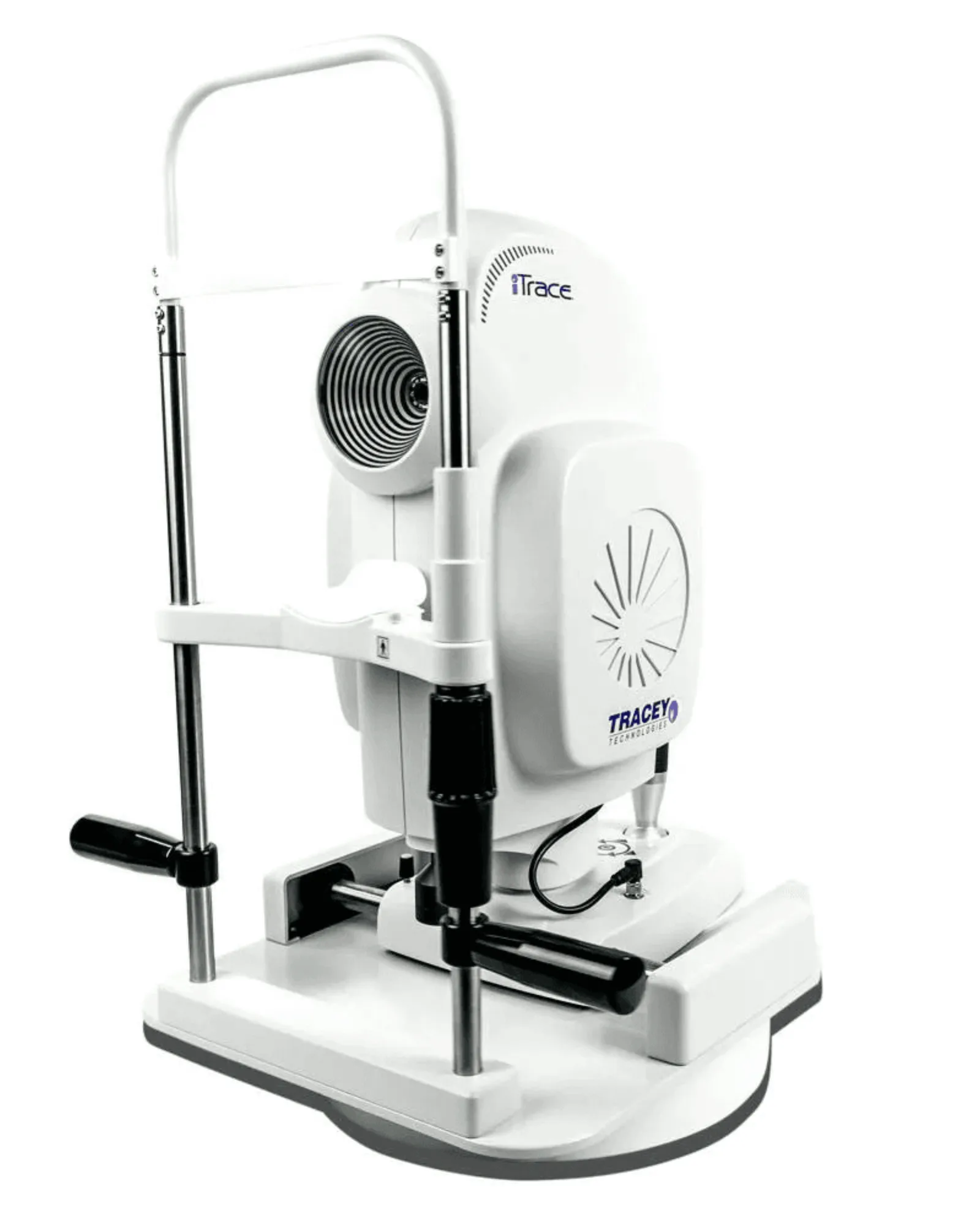
ITrace Wavefront Aberrometer
Abstract
The Tracey Technologies iTrace is a 5-in-1 ophthalmic diagnostic platform combining patented sequential ray-tracing aberrometry (256 points at 655/785nm wavelengths) with Placido-disk topography (24 rings, 8,640 points), autorefraction (±15D sphere/±10D cylinder), keratometry, and pupillometry (2.5-8mm range), uniquely separating corneal from internal aberrations and featuring proprietary DLI™/CPI™/QVI™ indices, marker-free Toric IOL planning/verification, and no-dilation post-op assessment capabilities.
DEVICE OVERVIEW
The iTrace is a 5-in-1 diagnostic ophthalmic system that combines wavefront aberrometry, corneal topography, autorefraction, keratometry, and pupillometry in a single integrated platform.
CORE TECHNOLOGY
Ray-Tracing Aberrometry
- Technology Type: Sequential ray-tracing (forward aberration measurement)
- Light Source: Near-infrared laser diode
- Wavelength: 655 nm (topography) and 785 nm (ray tracing aberrometry)
- Number of Measurement Points: 256 parallel laser beams projected sequentially
- Measurement Principle: Measures where each light ray lands on the retina and quantifies light energy transfer
- Unique Capability: Only aberrometer using forward ray-tracing (measures light going into the eye, not reflected back)
Corneal Topography
- Technology: Placido disk-based system (Vista format by EyeSys Vision)
- Number of Rings: 24 concentric rings
- Measured/Analyzed Points: 8,640 data points
- Corneal Coverage: 8 mm diameter on 42.5D sphere
- Dioptric Range: 33.75 to 61.36 D
TECHNICAL SPECIFICATIONS
Refraction Measurements
- Sphere Range: ±15.0 D
- Cylinder Range: ±10.0 D
- Measurement Accuracy: ±0.10 D
- Reproducibility: ±0.10 D
- Correlation with Manifest Refraction: T = 0.9925 (ranges -0.01 to -0.4 D)
Pupil Analysis
- Pupil Scan Size Range: 2.5 mm to 8.0 mm diameter
- Pupillometry: Automatic measurement under various lighting conditions
- Day/Night Vision Analysis: Pupil size tracking for photopic and mesopic conditions
Keratometry
- Measurement Type: Automated keratometry (flat and steep meridians)
- Based On: Combined corneal topography and wavefront data
- Applications: IOL calculations, toric lens planning, corneal power assessment
Aberration Analysis
- Lower-Order Aberrations (LOA): Sphere, cylinder, defocus
- Higher-Order Aberrations (HOA): Coma, trefoil, spherical aberration, secondary astigmatism, tetrafoil
- Zernike Polynomial Analysis: Complete wavefront decomposition
- Measurement Separation: Total, corneal, and internal (lenticular) aberrations analyzed separately
PHYSICAL SPECIFICATIONS
- Footprint Dimensions: 13.0 inches (33.0 cm) × 17.0 inches (43.2 cm)
- Weight: 27.4 lbs (12.4 kg / 20 kg depending on configuration)
- Portability: Compact, space-saving design suitable for clinical settings
- Capture Modes: Automatic and manual
CLINICAL ANALYSIS CAPABILITIES
Proprietary Indices (iTrace Prime Dashboard)
- **Dysfunctional Lens Index (DLI™)**Quantifies vision loss attributed to the crystalline lensScale: 0-10 (objective grading)Used for cataract diagnosis and premium IOL candidacy
- **Corneal Performance Index (CPI™)**Quantifies vision loss attributed to the corneaScale: 0-10 (objective grading)Identifies corneal aberrations and irregularities
- **Quality of Vision Index (QVI™)**Combined total eye visual quality metricSum of corneal and lenticular contributionsComprehensive vision assessment tool
- **Tear Film Index (TFI)**Assesses ocular surface stabilityEvaluates pre-operative tear film qualityCritical for refractive surgery screening
Visual Function Analysis
- Retinal Spot Diagram (RSD): Graphical representation of total refraction, aberrations, and point spread function
- Point Spread Function (PSF): Predicts retinal image quality
- Modulation Transfer Function (MTF): Contrast sensitivity analysis
- Multi-Zone Refraction Analysis: Refraction across different pupil zones
- Wavefront Maps: Color-coded aberration maps (values in microns)
SPECIALIZED CLINICAL FEATURES
Toric IOL Planning & Verification
- Toric Planner
toric calculator using advanced iTrace keratometryPortable eye image maps for precise intraoperative lens alignmentUses natural iris landmarks for marker-free alignmentOptical alignment angle measurement - Toric Check (Post-Operative):NO DILATION REQUIRED - 30-second examinationDetermines if toric IOL is off-axis or off-powerCalculates predicted BCVA change with lens rotationProvides rotation recommendations
Premium IOL Candidacy Assessment
- Visual Axis Identification: Locates patient's visual axis relative to pupil center
- Optical System Alignment: Determines multifocal IOL compatibility
- Kappa Angle Measurement: Assesses distance between visual axis and limbus center
- Pre-screening Tool: Predicts which patients will benefit from premium lenses
Patient Education Tools
- Visual Simulation: Shows patients their actual vision vs. corrected vision
- Snellen E Simulation: Demonstrates blurred vs. clear vision with/without correction
- Toric vs. Standard IOL Comparison: Visual comparison for astigmatic patients
- Objective Metrics: DLI, CPI, QVI communicated in patient-friendly format
DATA PROCESSING & OUTPUT
Acquisition & Analysis
- Scan Time: Under 1 minute for complete profile
- Data Processing: Point-by-point sequential analysis
- Internal Optometer: Automatic patient alignment and accommodation control
- Fogging Range: +7D to -5D (eliminates accommodation)
- Fixation: Binocular and monocular open-field (reduces accommodation)
Integration & Connectivity
- DICOM Compliance: Full integration (Version 6.3+)
- Network Capability: Networkable system
- Worklist Import: Managed worklist reduces data entry errors
- Batch Processing: Batch saving and printing capabilities
- Report Generation: Comprehensive, easy-to-interpret printable reports
Measurement Capabilities
- Over-Spectacle Measurement: Can measure through spectacles
- Post-Operative Analysis: Functions through IOLs, contact lenses, after LASIK
- Highly Aberrated Eyes: Effective even with significant optical irregularities
- Pseudophakia: Accurate measurements in patients with IOLs
- Cataract Assessment: Can measure through early cataracts
CLINICAL APPLICATIONS
Refractive Surgery
- Pre-operative screening and planning
- LASIK/PRK candidate evaluation
- Post-operative outcomes assessment
- Identifying causes of post-operative visual complaints
- Wavefront-guided treatment planning
Cataract Surgery
- Dysfunctional Lens Syndrome diagnosis
- Premium IOL candidate selection (multifocal, toric, accommodating)
- IOL power calculation optimization
- Toric IOL axis planning and verification
- Post-operative lens position assessment
General Ophthalmology & Optometry
- Differential diagnosis of vision complaints
- Corneal disease monitoring (keratoconus, irregular astigmatism)
- Contact lens fitting optimization
- Second-opinion evaluations
- Progression tracking of lens and corneal dysfunction
Research Applications
- Clinical studies requiring precise optical measurements
- Aberration analysis in various patient populations
- IOL performance evaluation
- Normal population reference databases
SOFTWARE VERSIONS & UPGRADES
Current Version: iTrace 7.0 (iTrace Prime)
Key Features:
- Prime Dashboard (DLI, CPI, QVI indices)
- Enhanced imaging quality
- Improved wavefront capture process
- Enhanced navigation between displays
- Batch saving and printing
- Toric Planner customization improvements
- Tech Triage icon (quality control for technicians)
- Exam Results display (validates scan quality)
Previous Major Versions:
- Version 6.3: Added DICOM compliance
- Version 6.1: Introduced Toric Check feature
- Version 6.0: Introduced Dysfunctional Lens Index (DLI)
- Version 4.0: Made diagnostic aberrometry accessible to all physicians
Upgrade Policy: Existing iTrace owners can upgrade software to access latest features
MEASUREMENT ACCURACY & VALIDATION
Clinical Studies
- High concordance with manifest refraction (T = 0.9925)
- More accurate than Hartmann-Shack aberrometers in post-refractive surgery eyes
- Excellent repeatability for spherical aberration and multiple aberrometric coefficients
- Intraclass correlation coefficients (ICC) > 0.96 for angle kappa measurements
Repeatability
- Low within-subject standard deviation (Sw) for most measurements
- Coefficient of variation (COV) better for lower-order aberrations
- Repeatability affected by tear film quality (assess tear film before imaging)
Interdevice Comparisons
- Comparable to Pentacam, OPD-Scan, and other aberrometers for specific parameters
- Unique capability to separate corneal from internal aberrations
- Different measurement principles may yield non-interchangeable Zernike coefficients
COMPETITIVE ADVANTAGES
- Only Ray-Tracing Aberrometer: Measures forward aberrations (how eye actually uses light)
- Corneal vs. Internal Separation: Only device that mathematically separates corneal from lenticular aberrations
- Post-Operative Capability: Accurate measurements through IOLs, contact lenses, after refractive surgery
- No Dilation Toric Check: Unique post-operative toric assessment without dilation
- 5-in-1 Integration: Eliminates need for multiple separate devices
- Patient Education: Visual simulation capabilities for enhanced patient communication
- Compact Footprint: Space-efficient design vs. multiple standalone devices
COMPATIBILITY & INTEGRATION
- Compatible with major EMR/EHR systems (via DICOM)
- Integrates with surgical planning software
- Exports data for IOL calculation programs
- Network-ready for multi-location practices
- Standalone computer included (HP Panel PC with Intel i5 processor)
CLINICAL VALIDATION & ADOPTION
- Used extensively in research institutions for clinical studies
- Adopted by thousands of ophthalmology and optometry practices worldwide
- Referenced in numerous peer-reviewed publications
- Standard of care for practices performing premium cataract surgery
- Endorsed by leading ophthalmologists for toric and multifocal IOL procedures
Visreed