

Humphrey Field Analyzer 3 - ZEISS
From the manufacturer
Zeiss: official product page
zeiss.com · opens in a new tab
Abstract
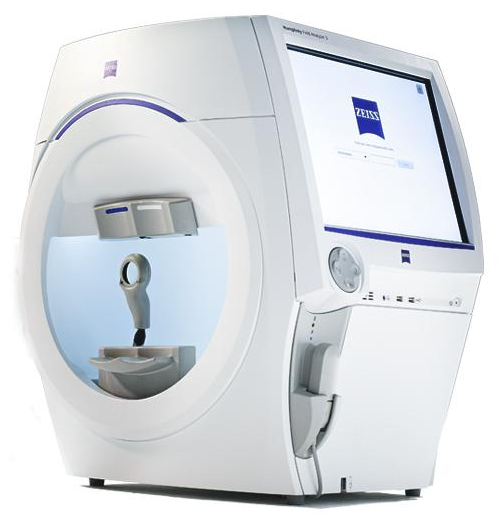
The Humphrey Field Analyzer 3 (HFA3) is ZEISS's automated static perimeter for testing the visual field, mainly in glaucoma and neuro-ophthalmic practice. Its SITA Faster strategy shortens a 24-2 test, the 24-2C pattern adds 10 macular points, and gaze tracking and the RelEYE eye image help to judge reliability. Guided Progression Analysis (GPA) compares each field with the patient's baseline to flag progression. The family has several models (830, 840, 850, 860) that differ in options such as kinetic testing, SITA-SWAP and the Liquid Trial Lens.
Core Technology Specifications
Instrument Type: Automated static perimeter with a bowl, touchscreen and patient response device
Models: 830, 840, 850 and 860; the 830 and 850 are not available in the US
Test Distance: 30 cm
Bowl Illumination: 31.5 apostilbs (asb)
Stimulus Duration: 200 ms
Maximum Temporal Range: 90°
Stimulus Sizes: Goldmann I to V, and 2°, 5° and 10° (model mapping not clear in the sources)
Strategies: SITA Standard, SITA Fast, SITA Faster and Full Threshold on all models; SITA-SWAP on the 850 and 860
Patterns: 24-2, 30-2, 10-2, 24-2C, 60-4, Nasal Step and Macula threshold tests, plus suprathreshold, Esterman and Social Security Disability tests
Kinetic Testing: Kinetic and custom kinetic on the 850 and 860 (not available in the US on the 840)
Tracking: Gaze tracking; head tracking and vertex monitoring on some models
Connectivity: FORUM and Glaucoma Workplace, DICOM (included except in the US and China, where it is optional), networking and USB; file-folder sharing with EMR systems
Interface: Touchscreen LCD with the SmartTouch color interface (select the patient, press start)
Dimensions and Weight: 580 x 510 x 460 mm (H x W x D) and 28.7 kg, as listed for the HFA3 840 by a distributor and matching the first set of values in the ZEISS brochure
Anatomical Context: What the Visual Field Measures
The visual field is the area of space that the eye sees while it looks straight ahead. Each point in the field corresponds to a point on the retina, and each retinal point sends its signal through the retinal nerve fiber layer, the optic nerve and the visual pathway to the visual cortex. Damage anywhere along this path produces a defect with a typical shape.
In glaucoma, loss of nerve fibers typically produces arcuate defects and a nasal step, and the central field is spared until late. In neurological disease, the defect respects the vertical midline, as in a bitemporal or homonymous hemianopia. In perimetry, sensitivity is expressed in decibels (dB), where a higher value means that a dimmer light can be seen.
How the System Works
- Static threshold perimetry: The patient fixates on a central target inside the bowl, which has a uniform background of 31.5 asb. Light stimuli of changing brightness appear for 200 ms at points across the field, and the patient presses a button each time a stimulus is seen
- SITA strategies: The software adapts the brightness presented at each point to estimate the threshold efficiently. SITA Faster is the fastest of the family: ZEISS states that it is about 50% faster than SITA Standard and about 30% faster than SITA Fast, with the same reproducibility
- Reliability tools: Gaze tracking follows the fixation during the test. RelEYE records an image of the eye at each stimulus, so the examiner can check whether an apparent defect came from a blink, a saccade or a loss of fixation
- Setup: Automated eye alignment centers the eye on the trial lens. The Liquid Trial Lens delivers the correction at the touch of a button and can load it from the previous exam. A promotional article gives a range of −8 to +8 D and says it reduces setup time and lens-rim artifacts
- Analysis: Measured sensitivities are compared with a normative database, and the results are shown as total deviation, pattern deviation and global indices such as MD, PSD and VFI
Test Patterns
- 24-2: The standard glaucoma pattern. SITA Faster 24-2 takes under three minutes per eye, according to a promotional estimate
- 24-2C: Adds 10 macular test points to the 24-2 grid, to catch early central damage. MD, PSD and VFI use all 62 points in Single Field Analysis
- 30-2: A wider field with more peripheral points
- 10-2: A dense central grid for macular and advanced glaucoma, and for neuro-ophthalmic follow-up
- Other tests: Screening and functional tests: suprathreshold patterns, Esterman (monocular and binocular) and Social Security Disability tests
- Kinetic (850 and 860): Kinetic and custom kinetic testing, to map isopters with a moving stimulus. ZEISS describes a graphical interface with a full 180° testing range
Guided Progression Analysis (GPA)
- VFI trend: A regression of the Visual Field Index values over time, which gives a rate of progression. VFI is considered less affected by cataract
- Glaucoma Change Probability Map: Identifies progression at individual test points across consecutive visits, compared with the baseline
- GPA Alert: Plain-language messages, such as possible or likely progression
- Compatibility: Mixed GPA lets SITA Faster, SITA Fast and SITA Standard tests be analyzed together, and it works with 24-2 and 30-2 tests from any HFA device. With five or more 24-2C tests, GPA analyzes all 62 points
- Structure and function: Fields can be combined with CIRRUS HD-OCT data, to compare retinal nerve fiber layer thinning with field loss
Data and Workflow
- Connectivity: Integrates with ZEISS FORUM through Glaucoma Workplace, which gives interactive review of HFA and GPA analyses, including dual baselines and Structure-Function GPA with CIRRUS. DICOM export is included except in the US and China, where it is optional
- Synchronization and legacy data: Data synchronizes across connected HFA3 devices, and legacy data can be transferred from the HFA II and HFA II-i
- Operation: The SmartTouch interface keeps the operation simple: select the patient and press start
- Efficiency: A manufacturer-supported article says the HFA3 saves setup time and can increase clinic capacity by up to 20%. This is a promotional claim
- Output and storage: Printing options include a thermal printer and PCL or PostScript printers (local, shared or networked), and tests are stored on an internal hard drive
Clinical Applications
- Diagnosis and follow-up of glaucoma and ocular hypertension
- Detection of early macular damage with the 24-2C pattern
- Neuro-ophthalmic testing, such as optic neuropathies, chiasmal and post-chiasmal lesions
- Monitoring of retinal disease and drug toxicity, for example with the 10-2 pattern
- Functional and legal tests, such as Esterman and disability tests
Who Can Use It
Ophthalmologists, glaucoma and neuro-ophthalmology specialists, and optometrists for diagnosis and monitoring. Orthoptists and technicians commonly run the test, instruct the patient and check fixation. The result must be interpreted together with the optic nerve, OCT and clinical findings.
Comparison of SITA Strategies
| Strategy | Speed | Note |
|---|---|---|
| SITA Standard | Reference | Full-length strategy |
| SITA Fast | Faster than Standard | Reference for the Faster comparison |
| SITA Faster | About half the time of Standard, 70% of Fast | Same reproducibility, per ZEISS |
| SITA-SWAP | Not stated in the sources | Blue-on-yellow, on 850 and 860 |
Strengths and Limits
Strengths: A long-established normative database and progression analysis, a faster test, gaze tracking and eye images for reliability, 24-2C for the macula, and links to FORUM and OCT data.
Limits: Perimetry depends on patient attention and fatigue, and a learning effect is common in first tests. The device is bulky, needs a dark room and takes several minutes per eye even with SITA Faster. Some functions depend on the model and the country.
About ZEISS
ZEISS Meditec is the medical technology business of Carl Zeiss. In glaucoma care it offers the HFA3 perimeter, CIRRUS HD-OCT and the FORUM data platform.
Limitations of Available Specifications
Note: The ZEISS product page and two brochures were used, but the brochure model comparison table was garbled in extraction, so RelEYE, Liquid Trial Lens, head tracking and vertex monitoring are not tied to a specific model. Power requirements were listed without labels and are not given. The speed claims, the 20% capacity gain and the Liquid Trial Lens range come from manufacturer or promotional material. The anatomy and perimetry background (visual field pathways, typical defects, decibel scale) and the general limits of perimetry (patient attention, learning effect, dark room) are standard clinical knowledge and were not taken from these sources. Please check the current ZEISS data sheet for your model and country. This content supports clinical judgement and does not replace it.