

EyeSeeCam Sci 2 - EyeSeeTec
Abstract
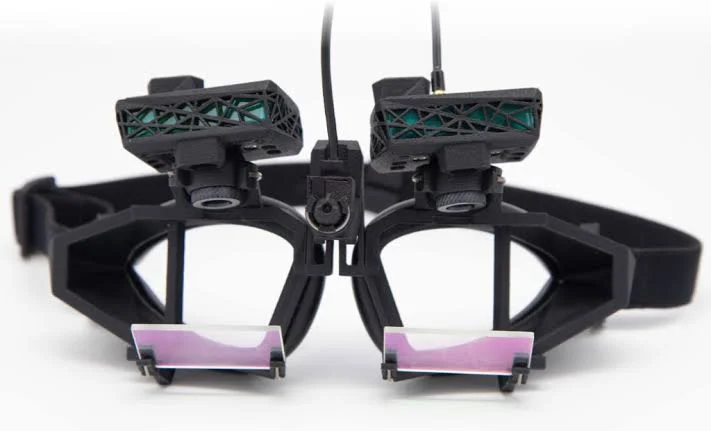
The EyeSeeCam Sci 2 is a head-mounted binocular video-oculography system. Two synchronized high-speed cameras record both eyes at up to 500 Hz, together with a 9-channel motion sensor. It supports the video head impulse test (horizontal and vertical) and a full oculomotor battery. It is the successor to the EyeSeeCam Sci 1 and to the monocular Interacoustics EyeSeeCam vHIT.
Core Technology Specifications
Imaging Platform: Binocular video-oculography (VOG), with dichroic mirrors in front of the eyes
System Type: Head-mounted eye tracker for neuro-otology and eye movement research
Cameras: Two synchronized high-speed cameras (binocular), 61 g for the cameras only
Frame Rate: Adjustable, up to 500 Hz (250 Hz is also used in studies)
Head Tracking: Inertial measurement unit with 9 channels: accelerometer, gyroscope and magnetometer, 3 axes each, synchronized with both cameras
Calibration: Laser with 5-point calibration, or on-screen calibration, depending on the set-up
Goggles: Flexible anti-slip frame for children and adults, several versions available (EyeMotion Goggles, 119 g)
Data Interface: Real-time interface via UDP/IP
Physiological Principle: the Vestibulo-Ocular Reflex
Head rotation stimulates the semicircular canals, and the vestibulo-ocular reflex (VOR) drives a compensatory eye movement in the opposite direction so that gaze stays stable on a target. In an ideal reflex, eye velocity equals head velocity in the opposite direction, giving a gain close to 1.0. In a canal with reduced function, the eye lags behind the head, and the patient makes catch-up (corrective) saccades to return to the target.
The head impulse test applies a small, fast and unpredictable head rotation in the plane of a canal pair. This loads the horizontal (lateral) canals, or the RALP and LARP vertical canal pairs, one side at a time.
How the System Measures
- Optical path: Dichroic (hot) mirrors let visible light pass, so the patient sees the room normally, and they reflect infrared light to the cameras, which image the pupils
- Eye tracking: Each camera tracks the pupil to determine eye position. The two cameras are synchronized, so both eyes are recorded at the same instants
- Head tracking: The motion sensor records head movement on 9 channels, synchronized with both cameras, which supports analysis of head and eye velocity together
- Calibration: A laser 5-point calibration or an on-screen calibration converts the pupil position to degrees of eye rotation
Why Binocular Recording Matters
Most vHIT systems record one eye at a time. A binocular system records both eyes during the same head impulse, so the movement of the adducting and the abducting eye can be compared directly.
- Gain per eye: The VOR gain of the adducting eye and of the abducting eye can be measured in a single impulse
- Dysconjugacy: Differences between the two eyes can be quantified with a dysconjugacy ratio (vorDR), as used in published normative work with this device
- Central and ocular motor findings: Eye movements that differ between the two eyes, such as deconjugate movements, can be seen and recorded. These cannot be evaluated with a single camera
- Workflow: Both eyes are tracked at the same time, so there is no need to switch the camera between recordings
Available Protocols
- Saccades
- Smooth pursuit
- Head impulse test (vHIT), horizontal and vertical
- Optokinetic nystagmus
- Gaze-evoked nystagmus
- VOR suppression
- Caloric test
- Video Frenzel
- Subjective visual vertical (SVV)
- Vergence
Software and Data
- Trial management: Integrated trial management with a database for results
- Statistics: Built-in statistical evaluation functions
- Real-time interface: Real-time interface via UDP/IP for integration with other set-ups
- Computer: A Mac-based computer, for example a MacBook Air M1 with at least 4 GB RAM (the full requirement list was not retrievable)
Hardware and Ergonomics
- Frame: Flexible, anti-slip frame suitable for children and adults, with different versions available
- Weight: 61 g for the cameras and 119 g for the EyeMotion goggles
- Layout: Camera modules carried above the eyes, with mirrors in front of each eye
Clinical and Research Applications
- Video head impulse testing in dizzy patients, with binocular gain analysis
- Oculomotor testing: saccades, pursuit, optokinetic and gaze-evoked nystagmus
- Vergence and subjective visual vertical assessment
- Caloric testing and video Frenzel recording
- Eye movement research requiring high frame rates and synchronized head tracking
Who Can Use It
ENT specialists, neurologists, neuro-ophthalmologists and vestibular specialists for balance disorders. Orthoptists and optometrists can use it for oculomotor assessment (saccades, pursuit, vergence and nystagmus), and researchers can use it for high-speed eye tracking.
Comparison with the Previous Generation
| Feature | EyeSeeCam vHIT | EyeSeeCam Sci 2 |
|---|---|---|
| Camera | Monocular, switchable | Binocular, synchronized |
| Sampling rate | 220 Hz | Up to 500 Hz |
| Head sensor | IMU, 6 degrees of freedom | IMU, 9 channels |
| Calibration | Laser, 5-point | Laser 5-point or on-screen |
| Weight | 72 g (goggle + camera) | 61 g cameras + 119 g goggles |
| Interface | USB 2.0 | UDP/IP real-time interface |
Strengths and Limits
Strengths: Synchronized binocular recording, high frame rate, a motion sensor with a magnetometer, a wide protocol list and a real-time data interface.
Limits: Head impulse quality still depends on the examiner, with adequate velocity and a correct plane. Poor goggle fit or slippage and eyelid or pupil artifacts degrade data. The system is positioned for research applications, so regulatory status for clinical use should be checked for your region.
Limitations of Available Specifications
Note: The camera resolution, infrared wavelength, latency, field of view, full computer requirements and the clinical regulatory status of the Sci 2 were not available in the documentation reviewed. Contact EyeSeeTec for the complete datasheet and pricing. This content supports clinical judgement and does not replace it.
Visreed