

Elara 900 - Haag-Streit
Abstract
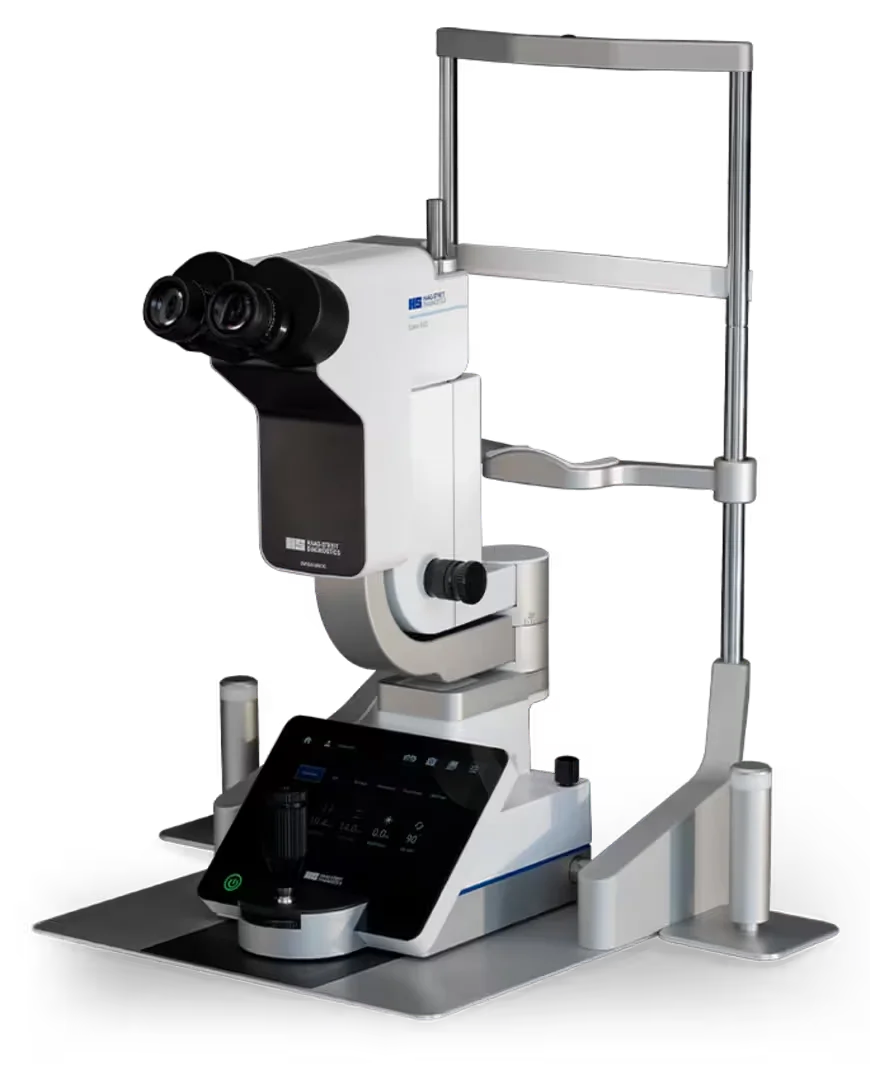
The Elara 900 is a digital slit lamp from Haag-Streit. It combines Haag-Streit's Galilean optics with a projector-based "P-Type" light source that can emit colors across the visible spectrum, with infrared available for meibomian gland assessment. Motorized height and magnification, six user presets and an optional dual-camera system with 3D and 4K capture complete the design. It was launched at ESCRS 2025 and presented in the US at AAO 2025.
Core Technology Specifications
Instrument Type: Slit lamp biomicroscope with projector illumination and integrated imaging option
Illumination: Projector light source ("P-Type"), RGB colors
Spectral Range: Visible 420 to 660 nm; infrared 780 to 900 nm (Elara 900 only)
Slit Image: Width 0 to 24 mm continuous; height 0 to 15 mm continuous; rotatable ±90°
Maximum Irradiance: 174 mW/cm²
Microscope: Galilean stereo microscope, stereo angle 13°
Magnification: 6.3x / 10x / 16x / 25x / 40x, motorized, with 12.5x eyepieces
Camera: 2 x 5 MP for stereoscopic view, up to 4K image and video output in stereo mode (3D license required)
Instrument Base: Single-handed 3D joystick; travel 100 mm (length), 100 mm (side), 30 mm (height)
Dimensions and Weight: 560 x 401 x 330 mm (L x W x H); 15.2 kg
Anatomical Context: What a Slit Lamp Examines
A slit lamp projects a thin, bright beam of light into the eye, and the examiner views the illuminated section through a stereo microscope. This allows optical sectioning of transparent structures. It is used on the eyelids and lid margin, tear film, conjunctiva, sclera, cornea, anterior chamber, iris, lens and anterior vitreous. With auxiliary lenses, the same instrument is also used for the posterior segment, including the optic disc and macula.
The Elara 900 targets these examinations with controllable illumination. The slit width and height, the beam angle and the light color are all adjustable, so different structures and pathologies can be highlighted.
How the System Works
- P-Type illumination: A projector, rather than a conventional lamp with a mirror, shines the light directly onto the eye. It can modulate its output across the visible spectrum, so the color temperature can be selected for each pathology
- Optics: The Galilean microscope offers five magnification steps from 6.3x to 40x. Object field diameter is 32.0, 20.0, 12.7, 8.0 and 5.1 mm, from low to high magnification
- Contrast: A motorized yellow filter increases contrast in specific areas, for example in fluorescein examination
- Infrared: Infrared illumination between 780 and 900 nm supports meibomian gland assessment. The product page marks it with an asterisk, so check which license or configuration it requires
- Motorization: The motorized height adjustment and the motorized magnification changer are operated from the joystick, so the examiner does not need to take the hand away
Presets
Up to six individual examination scenarios, called presets, can be stored and applied with one scroll of the preset wheel. A preset can combine the illumination color, the yellow filter, the slit width and the magnification, replacing several manual steps with one operation.
Imaging and Documentation
- Dual camera: Two cameras of 5 MP each give a stereoscopic view, with up to 4K image and video output in stereo mode
- Camera beam: The camera beam can be defined in the software as stereo, left or right
- Frame rate and formats: 30 fps; images in JPG or BMP, and videos in MP4
- Beam splitting: An automatic flip mirror switches transmission to the camera between 0% and 70%
- Capture: A single click of the joystick button records an image or video. The captured content can be assigned to the correct patient file within the device
- Licenses: 3D capture requires a 3D license. Integration with EyeSuite, or with an EMR supporting the DICOM modality worklist, requires a Connectivity license
- VisionCast: A Google TV Streamer is supplied for Haag-Streit's VisionCast, which shares the view for teaching
Ergonomics
- Eyepieces: Inclined oculars at 20° encourage a natural head and neck position. Adjustment range is +8 to −8 dioptres with a pupil distance of 52 to 80 mm
- Controls: Control elements sit around the joystick so essential adjustments do not require moving the hand. The distance from the ocular to the focus lens is 23% shorter than on slit lamps with a similar feature set, according to the manufacturer
- Patient comfort: A height-adjustable chinrest and a spacious headrest give room to patients of different body frames
- Touchscreen: An intuitive touchscreen layout operates the system
Connectivity and Power
- Wireless: Intel Wireless-AC 9260 module at 2.4 GHz, 20 dBm (100 mW)
- Power supply: 100 to 240 VAC, 47 to 63 Hz, 159 VA
Clinical Evidence and Reported Feedback
- Visualization: In a clinician survey reported in The Ophthalmologist, 77.6% reported improved binocular visualization, and none reported inferior visualization compared with their usual slit lamp
- Workflow: A presenter reported a slightly shorter mean examination time with the Elara 900 than with a conventional slit lamp, while new users often spend extra time exploring its features and recording videos
- Interpretation: These results come from manufacturer-supported communication and clinician feedback, not from an independent controlled trial
Clinical Applications
- Routine anterior segment examination of the lids, cornea, conjunctiva, anterior chamber, iris and lens
- Posterior segment examination with auxiliary lenses
- Dry eye and meibomian gland assessment using infrared illumination
- Documentation of findings in 3D and 4K for follow-up and referral
- Teaching and case discussion with stereoscopic visualization
Who Can Use It
Ophthalmologists and optometrists in general and specialist practice, orthoptists and technicians for anterior segment documentation, and residents and students for supervised teaching.
Comparison with a Conventional Slit Lamp
| Feature | Conventional | Elara 900 |
|---|---|---|
| Illumination | Fixed spectrum | P-Type, adjustable colors |
| Height | Manual | Motorized |
| Magnification | Manual changer | Motorized, from the joystick |
| Settings | Manual steps | Up to six presets |
| Documentation | Add-on camera | Integrated dual camera, 3D and 4K |
Strengths and Limits
Strengths: Adjustable colored and infrared illumination, motorized controls, user presets, stereo imaging and a design focused on ergonomics.
Limits: 3D capture and EMR connectivity need separate licenses. At 15.2 kg it is a fixed instrument. Magnification moves in five discrete steps, and pricing is not public. New users need time to learn the presets and imaging features.
About Haag-Streit
Haag-Streit is a Swiss manufacturer of ophthalmic instruments, known for its slit lamps and Goldmann applanation tonometry. The Elara 900 was announced together with the Refractor 900 digital phoropter, and both debuted at ESCRS 2025 in Copenhagen, with a US premiere at AAO 2025.
Limitations of Available Specifications
Note: The regulatory clearance details, the exact configuration or license needed for infrared illumination, the 4K sensor specifications beyond the stated 2 x 5 MP, and pricing were not available in the documentation reviewed. Much of the performance evidence comes from the manufacturer and its collaborators. Contact Haag-Streit or an authorized distributor for the full datasheet. This content supports clinical judgement and does not replace it.
Visreed