

Aurora IQ - Optomed
From the manufacturer
Optomed: official product page
optomed.com · opens in a new tab
Abstract
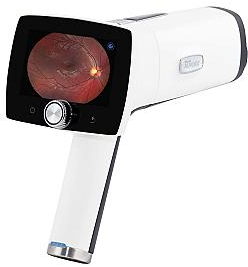
Aurora IQ is a handheld, non-mydriatic fundus camera from Optomed (Finland). It has a 5 MP sensor, a 50° field of view, a minimum pupil of 3.1 mm, automatic focus and exposure, and a built-in image quality analysis that guides the operator. An anterior module for eye surface imaging is part of the full set. An AI screening service is optional. The AI approval that Optomed announced for the Aurora family concerns the Aurora AEYE, not the Aurora IQ, and the pages reviewed do not state a regulatory status for an Aurora IQ with AI.
Core Technology Specifications
Instrument Type: Handheld, non-mydriatic fundus camera with an anterior module
Field of View: 50° (listed by a reseller as 50 x 40)
Sensor: 5 MP
Optical Resolution: Above 60 lp/mm, with reference to ISO 10940:2009 (reseller listing)
Minimum Pupil Size: 3.1 mm (reseller listing)
Focus and Exposure: Automatic focusing and automatic exposure
Image Quality Analysis: Built in; Optomed says it helps first-time users obtain good images
Display: 4-inch TFT-LCD, 800 x 480 pixels
Battery: Rechargeable Li-ion, 3.63 V / 2,600 mAh; about 2 hours of continuous use (reseller listing)
Connectivity: WLAN and USB; secure data transfer to hospital systems is described by Optomed
Mounting: Used handheld, or mounted on a slit lamp (Australian distributor description)
Weight: Camera 526 g; retinal module 327 g; anterior module 105 g
Dimensions (W x H x L): Camera 122 x 202 x 98 mm; retinal module 68 x 74 x 160 mm; anterior module 71 x 80 x 79 mm
Full Set Includes: Camera, retinal module, anterior module, 2 batteries, power supply, 2 eyecups, charging station, USB cable, client software for image transfer, carrying case (reseller listing)
Anatomical Context: The 50° Field
A 50° image shows the posterior pole: the optic disc, the macula and the major vascular arcades. This is the region used for common screening tasks such as assessing the disc for cupping or swelling and the macula and arcades for diabetic changes. It is not a widefield or peripheral view, so peripheral lesions can lie outside a single image.
This paragraph is general clinical background and is not taken from the sources.
How the System Works
- Handheld capture: The operator holds the camera, the integrated screen shows the live retinal view, and the camera sets focus and exposure automatically
- Quality check: The built-in image quality analysis is intended to guide capture. Its criteria are not stated in the sources
- Modules: The retinal module and the anterior module are interchangeable heads on the same camera body, so one device covers the fundus and the eye surface
- Data: Images are transferred by WLAN or USB. Optomed's companion software includes Avenue Viewer, Avenue Telemedicine and Avenue Eye Screen; these are separate products and not specifications of the camera
- Optional AI: An optional AI service can show a screening result on the camera display, according to a distributor page. The sources do not say which conditions or what performance apply to the Aurora IQ itself
Clinical Applications
- Fundus documentation in clinics, primary care and community settings, without dilation
- Telemedicine and remote reading of images
- Screening programs, for example for diabetic retinopathy when used with a validated AI service
- Documentation of the disc, for example in glaucoma follow-up or papilledema, as listed by a distributor
- Anterior segment photography with the anterior module
- Teaching and research documentation
Aurora IQ Compared With Other Optomed Aurora Cameras
| Item | Aurora IQ | Note |
|---|---|---|
| Field of view | 50° | An Optician Online article gives 50° for the original Aurora |
| Anterior module | Part of the full set | Optomed lists it for the IQ full set |
| AI | Optional service | The AEYE AI approval concerns the Aurora AEYE |
Strengths and Limits
Strengths: Portable and non-mydriatic, with automatic capture aids, an anterior module, a 4-inch screen and an optional AI service. It is compact (526 g for the camera body).
Limits: A 50° field covers the posterior pole only. The minimum pupil of 3.1 mm is larger than that of some tabletop systems. The battery lasts about 2 hours. AI status for the IQ is not clear in the sources, and no clinical study of the Aurora IQ was found.
About Optomed
Optomed is a Finnish maker of handheld fundus cameras, with products including the Aurora family, the Lumo and the Avenue screening software.
Limitations of Available Specifications
Note: Most numeric specifications (resolution, minimum pupil, display, battery, weight, dimensions, accessories) come from a single European reseller listing and were not checked against an Optomed document. The 50° field and the automatic functions are stated by several pages. One launch article describes the Aurora IQ as capturing fluorescein images; this is unusual for a handheld color camera, was not confirmed elsewhere, and is not included here. The dioptric compensation range, the launch date, the regulatory status by country, the AI conditions and performance, and any clinical study of the Aurora IQ were not found. Please check Optomed's current documentation. This content supports clinical judgement and does not replace it.
Sources
- Optomed AURORA IQ Fundus Camera, Eickemeyer (specifications)
- Insight News: New Aurora IQ handheld fundus camera (Australia): https://www.insightnews.com.au/new-aurora-iq-handheld-fundus-camera/
- Optomed feature article (Aico, PDF)
- Aimil: Aurora IQ product page: https://www.aimil.com/products/aurora-iq
- Eyes On Eyecare: Optomed USA launches next-gen handheld fundus camera: https://glance.eyesoneyecare.com/stories/2025-08-05/optomed-usa-launches-next-gen-handheld-fundus-camera/
- Optician Online: Optomed targets eye disease (Aurora): https://www.opticianonline.net/content/news/optomed-targets-eye-disease
- Optomed Oyj: Aurora with AEYE FDA clearance: https://news.cision.com/optomed-oyj/r/inside-information--optomed-aurora-with-aeye-has-received-fda-clearance-in-the-us,c3971100