

ARGOS Biometer - Alcon
From the manufacturer
Alcon: official product page
myalcon.com · opens in a new tab
Abstract
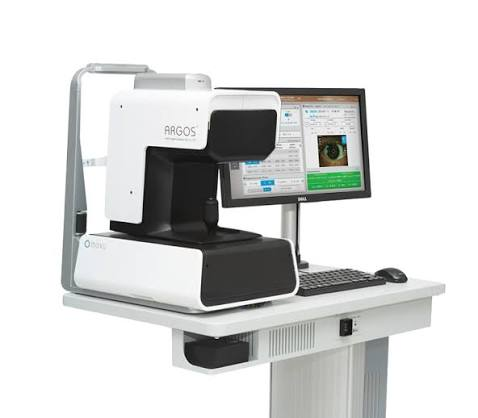
The ARGOS is a non-contact optical biometer based on swept-source OCT (SS-OCT). It was developed by Movu and is distributed by Alcon. In under one second it acquires axial length, corneal thickness, anterior chamber depth, lens thickness, keratometry and pupil size, and it gives an angle-to-angle, cornea-to-retina OCT image to guide the measurement. It supports IOL calculation and toric planning, and it connects to Alcon's Vision Planner software.
Core Technology Specifications
Imaging Platform: Swept-source OCT (SS-OCT), non-contact, with a 1 µm near-infrared swept laser
System Type: Tabletop optical biometer with a Windows-based interface and a joystick
Scan Time: Less than 1 second (six sequential images, according to CRST Europe)
Imaging Output: 2D cross-section or 3D volume; angle-to-angle, cornea-to-retina OCT image
Keratometry: Ring of 16 infrared LEDs combined with OCT signals
Axial Length Method: Segmented axial length
Dimensions and Weight: 310 x 485 x 510 mm; about 21 kg (without the AC adapter and cable)
Power: 24 VDC device input; AC adapter 100 to 240 VAC, 50/60 Hz; consumption 180 to 250 VA
Regulatory Status: FDA and CE (as listed by a distributor)
Measurement Ranges
| Parameter | Range (distributor listing) |
|---|---|
| Axial length | 15 to 30 mm |
| Anterior chamber depth | 1.5 to 5.0 mm |
| Lens thickness | 0.5 to 6.5 mm |
| Corneal thickness | 300 to 800 µm |
| White-to-white | 7 to 15 mm |
| Pupil diameter | 2 to 13 mm |
These ranges come from a distributor's product page, not from the manufacturer's data sheet, so please check them against Alcon's documentation. Resolution and repeatability values were not found in the sources reviewed.
Anatomical Context: What Cataract Biometry Measures
IOL power depends on a few distances inside the eye and on the curvature of the cornea. The axial length from the corneal vertex to the retina has the largest effect, because a small error in length produces a large refractive error. The anterior chamber depth and lens thickness help to predict where the IOL will sit, and corneal curvature gives most of the eye's focusing power.
With OCT, the beam crosses the eye and records reflections from each interface. The ARGOS therefore shows the anatomy as an image, so the examiner can see whether the beam reached the fovea and whether the measurement is valid.
How the System Works
- SS-OCT: A swept laser at about 1 µm scans across the eye. The software rebuilds the eye's structure in real time from the reflections at the optical boundaries
- Segmented axial length: The axial length is built from the individual segments of the eye, for example corneal, anterior chamber, lens and vitreous. The manufacturer says this method improves the prediction of the refractive result
- Keratometry: A ring of 16 infrared LEDs reflects on the cornea and, with the OCT signal, gives corneal curvature data
- Guidance and capture: Tracking markers on the screen guide alignment, and a joystick button starts capture. The technician reviews the 2D images and can fine-tune the result
- Image guidance: The OCT image gives a view from angle to angle and from cornea to retina, which lets the examiner confirm what was measured
Dense Cataract Performance
- Sensitivity: CRST Europe reports 10 times greater sensitivity than partial coherence interferometry, and up to 100 times for axial length detection in Dense Cataract mode
- Manufacturer comparison: Alcon states that the ARGOS outperformed the IOLMaster 700 by 41% in grade 4 and above cataracts
- Interpretation: These are manufacturer and trade-press figures. Independent comparison studies exist but were not reviewed in full
Software and IOL Planning
- IOL formulas: Holladay I, SRK/T, Haigis and Hoffer Q, using lens constants from the User Group for Laser Interference Biometry (ULIB) library
- Planning: Vision Planner offers astigmatism management tools, including an LRI nomogram for arcuate incision planning
- Toric alignment: Toric IOL axis alignment is mapped to the patient's limbal and iris landmarks
- Surgical integration: The plan can be transferred to Alcon's LenSx laser and the Digital Marker Microscope, which reduces transcription errors between clinic and operating room
- Connectivity: DICOM compatible, with an internal Ethernet LAN connection, SSL/TLS (port 443) and FTP support; the manufacturer recommends more than 100 Mbit bandwidth
Speed and Workflow
- Acquisition: The scan takes under one second, and Alcon states that the acquisition rate is 1.5 times faster than the IOLMaster 700
- Operation: One-touch operation and remote planning options are offered
- Environment: Operating conditions are 15 to 35 °C, 30 to 70% humidity and 800 to 1060 hPa. The expected lifespan is 8 years
Clinical Applications
- Biometry and IOL power calculation before cataract surgery
- Toric IOL planning and astigmatism management
- Measurements in dense cataracts
- Image-guided verification of measurements through OCT
- Surgical plan transfer to compatible Alcon operating room systems
Who Can Use It
Cataract and refractive surgeons for planning, and optometrists, orthoptists and technicians for the acquisition in the pre-operative work-up. Interpretation and IOL selection remain with the surgeon.
Comparison with Partial Coherence Interferometry
| Feature | PCI biometer | ARGOS (SS-OCT) |
|---|---|---|
| Technology | Partial coherence interferometry | Swept-source OCT |
| Image of the eye | Limited | Angle-to-angle OCT image |
| Dense cataract | Lower sensitivity | Higher sensitivity, Dense Cataract mode |
| Axial length | Single value | Segmented |
| Contact | Non-contact | Non-contact |
Strengths and Limits
Strengths: Fast non-contact acquisition, an image that lets the examiner verify the measurement, strong performance in dense cataract according to the manufacturer, a link to the planning and surgical workflow, and a segmented axial length method.
Limits: It is a heavy tabletop unit of about 21 kg. Its four classic IOL formulas are listed, while newer formulas may be run in Vision Planner or outside software, which could not be confirmed. Poor fixation and corneal or tear film problems can still prevent a valid measurement.
About Movu and Alcon
Movu developed the ARGOS, and Alcon markets it as part of its cataract surgery portfolio, together with the LenSx laser and the Vision Planner software.
Limitations of Available Specifications
Note: The sources reviewed were trade-press articles, Alcon product and specification pages and a distributor listing. The exact laser wavelength, measurement resolution and repeatability, laser class, the number of keratometry points, the list of IOL formulas in current software versions and pricing were not available. Two comparison studies against the IOLMaster 700 could not be read in full. Contact Alcon for the current data sheet. This content supports clinical judgement and does not replace it.